In biobanking, identification errors rarely cause immediate failure. Their consequences often surface much later, sometimes months or even years after storage.
A mislabeled tube. A manually transcribed code. A rack repositioned without scanning. Individually, these events may seem minor. Over time, however, they accumulate and can evolve into operational risk in systems expected to remain stable for years.
When samples are stored at ultra-low temperatures for extended periods, identification is not just a labeling step. It becomes part of long-term sample integrity and operational control.


This is where the choice between 1D and 2D coding shifts from convenience to strategy.
Beyond “Which Is Better?”
The comparison between 1D and 2D coding is often simplified into technological advancement. In practice, the decision is operational.
The relevant question is not which coding system is more advanced, but what level of traceability your laboratory actually requires.
How many samples are you managing? How quickly is that number growing? How structured is your workflow today, and how likely is it to evolve?
In many laboratories, linear barcodes remain a reliable and appropriate solution.
They are simple, widely compatible, and effective in environments where processes are still largely manual.
However, as storage volumes increase and workflows become more structured, identification begins to interact with automation, rack organization, and data consistency in a different way.
CLEARLine® CryoGen® Tubes
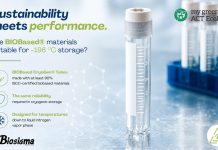
CLEARLine® CryoGen® tubes by Biosigma are designed for cryogenic storage down to −196 °C. All tubes in the range feature a Code 128 linear barcode on the tube body.
CLEARLine® 2D CryoGen® tubes, available in 2 ml and 5 ml formats, integrate a permanently laser-etched 2D DataMatrix code on the tube bottom.
The distinction is not about cryogenic resistance. Both 1D and 2D tubes share the same material performance platform. The difference lies in how identification integrates into the workflow.
Operational Comparison:
| Feature | CLEARLine® 1D | CLEARLine® 2D |
| Cryogenic suitability (−196 °C) | X | X |
| Code 128 linear barcode | X | X |
| Bottom 2D DataMatrix | X | |
| Manual handheld scanning | X | X |
| Rack-based bottom scanning | X | |
| Automation readiness | X | |
| Reduced manual transcription risk | X |
When 2D Changes the Equation
In many laboratories, traceability begins with linear barcodes. For small to medium sample volumes, 1D coding remains entirely appropriate.
As storage volumes expand and workflows become more structured, identification starts to interact more closely with daily operations. And so, automation of bottom reading and rack-based scanning become part of long-term planning.
In this context, 2D bottom coding becomes relevant not as an upgrade, but as a way to reduce reliance on manual processes.
The ability to read multiple tubes simultaneously allows traceability to scale more effectively with system complexity, reflecting how the shift from 1D to 2D is a reaction to growth, not failure.
For this reason, solutions such as CLEARLine® 2D CryoGen® tubes, featuring permanently laser-etched DataMatrix codes, are designed to maintain readability and data consistency throughout long-term cryogenic storage, even under repeated handling conditions.
How to Decide Between 1D and 2D
Before selecting a coding approach, it is important to consider how your laboratory operates today and how it is likely to evolve over time:
- How many samples are currently in storage?
- Is this volume expected to increase significantly?
- Are racks frequently reorganized?
- Is manual data transcription still part of the process?
If work processes remain stable and largely manual, 1D coding may be a sufficient solution.
However, as sample volumes grow and the need for scalability, automation and traceability becomes more relevant, 2D bottom coding may align better with long-term development.
Traceability as a Structural Decision
In cryogenic biobanking, the decision is not about choosing the most advanced option. It is about selecting the level of traceability that best supports your operational trajectory.
Biosigma’s solutions are designed to support both approaches, allowing laboratories to align their choice with their specific needs.
About the Author
Biosigma S.p.A., founded in 1988, provides disposable plastic items for biotechnology, research, clinical chemistry and pharmaceutical laboratories. Our CLEARLine® products are ideal for the most sensitive applications. Products are manufactured under strict quality standards and certified by our internal laboratory.