
- Large-scale tissue data resource: The HuBMAP Data Portal contains 9,316 published datasets derived from 5,142 registered tissue samples across 501 donors, spanning 29 organ classes.
- Standardized data infrastructure: Harmonized metadata, processing pipelines, and provenance tracking support the integration of molecular and spatial data generated across multiple institutions.
- Research accessibility: Interactive visualization, searchable datasets, and cloud-based analysis tools help researchers explore and reuse human tissue-derived data.
Researchers have detailed the infrastructure behind the National Institutes of Health (NIH) Human BioMolecular Atlas Program (HuBMAP) Data Portal, a resource designed to make complex molecular and spatial data from healthy human tissues accessible and reusable across research institutions.
The study, published November 2 in Nature Communications, describes a platform containing 9,316 public datasets representing 5,142 registered tissue samples from 501 donors, spanning 26 data types and 29 organ classes as of August 2026.
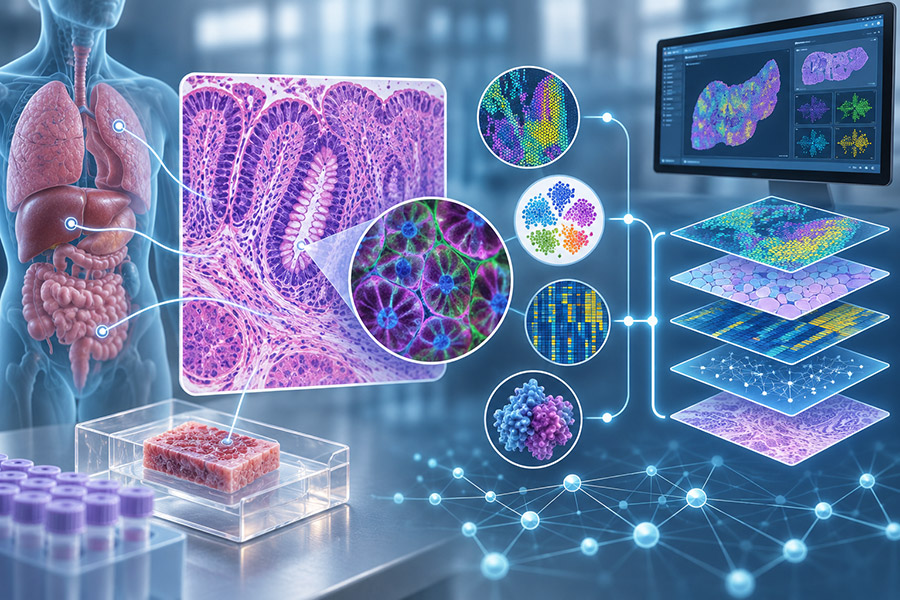
Developed through the NIH-funded HuBMAP consortium, the portal combines tissue-derived molecular profiles, imaging data, standardized metadata, and computational tools to support the construction of a reference atlas of healthy human tissues.


Rather than announcing a newly launched repository, the publication provides a comprehensive account of how an established research infrastructure enables data integration, visualization, and reuse across laboratories and experimental technologies.
Connecting Human Tissue Samples With Multimodal Data
Launched in 2018, HuBMAP aims to map the cellular organization of healthy human tissues, providing a reference for understanding normal biological function and investigating changes associated with disease.
The newly described resource draws on multiple experimental approaches, including single-cell and single-nucleus RNA sequencing, spatial transcriptomics, proteomics, and advanced tissue imaging.
The portal includes data from organs such as the kidney, lung, heart, intestine, uterus, and placenta, although representation varies considerably among tissues and technologies.
Importantly, the reported 5,142 samples include registered tissue entities such as tissue blocks, sections, organs, and cell suspensions. The figure should not be interpreted as an inventory of independently available physical biospecimens.
For biobanking professionals, the distinction between physical collections and their associated digital resources is significant. A single tissue specimen may generate multiple molecular or imaging datasets, extending its research value beyond its original experimental application.
Standardizing Metadata and Preserving Sample Provenance
A central feature of the HuBMAP infrastructure is its ability to maintain traceable relationships between tissue donors, biological samples, experimental assays, and resulting datasets.
The portal organizes these relationships through a structured provenance model that records how raw experimental data are generated, processed, and transformed into research-ready outputs.
To improve comparability across participating institutions, HuBMAP employs standardized metadata schemas, validation procedures, and data-type-specific processing pipelines.
These systems help address a longstanding challenge in multicenter biospecimen research: data generated from similar tissues may be difficult to compare because laboratories use different experimental methods, documentation practices, or computational workflows.
The portal also records processing histories and pipeline versions, allowing researchers to evaluate how datasets were generated and whether they are suitable for combined analysis.
This approach reflects the broader importance of interoperable biobanking infrastructure, where standardized metadata and sample traceability can be as important as the physical preservation of specimens.
However, standardized computational processing does not eliminate biological or pre-analytical variability. The authors acknowledge differences in sample quality and emphasize that data submitters retain responsibility for reviewing datasets before publication.
Making Tissue-Derived Data Searchable and Reusable
Beyond data storage, the HuBMAP Data Portal provides tools that allow researchers to discover, visualize, and analyze tissue-derived information without necessarily downloading large datasets.
Its search functions support queries using donor characteristics, anatomical locations, experimental methods, molecular markers, and cell types.
Interactive Vitessce visualizations were available for 5,135 datasets across 19 of the 26 supported data types as of August 2026, enabling users to explore spatial and single-cell measurements directly through a web browser.
Researchers can also use integrated computational Workspaces to analyze datasets with Python or R, supporting comparisons across samples and experimental modalities.
For biobanks seeking to improve the accessibility of biospecimen-associated data, these capabilities demonstrate how digital infrastructure can make complex collections more discoverable and analytically useful.
Related developments are also emerging in AI-ready datasets built around academic biobanks, although HuBMAP focuses primarily on reference mapping of healthy tissues rather than assembling disease-specific clinical cohorts.
Access remains subject to data-governance requirements. While published public datasets are broadly accessible, some sensitive data, including certain raw human sequencing files, require controlled access through mechanisms such as the NIH database of Genotypes and Phenotypes (dbGaP).
Implications for Biobanks and Remaining Challenges
The HuBMAP resource illustrates how the scientific value of human biospecimens can be extended through standardized metadata, documented processing histories, anatomical context, and reusable molecular datasets.
For biobank operators, its infrastructure offers practical lessons in digital sample provenance, cross-institutional harmonization, and the application of FAIR data principles—making research data findable, accessible, interoperable, and reusable.
Nevertheless, the authors identify important limitations. Donor representation does not reflect the full diversity of human populations, and tissue coverage remains uneven across organs and experimental methods.
Automated cell-type annotations are currently supported for datasets from only three organs: the heart, lung, and kidney. Emerging experimental technologies also create continuing challenges for standardization and computational scalability.
These limitations matter when researchers use healthy tissue reference datasets to interpret disease-associated changes or develop computational models.
HuBMAP therefore demonstrates both the opportunities and the operational demands of large-scale biospecimen-derived data integration.
For the biobanking community, its significance lies not simply in the volume of available molecular data, but in the infrastructure that connects those data to their biological origins and supports responsible reuse across research institutions.
About the Author

Biobanking.com delivers valuable news and information on biobanking, biorepositories, cryopreservation, and biosample/biospecimen management, while connects buyers with top vendors globally.