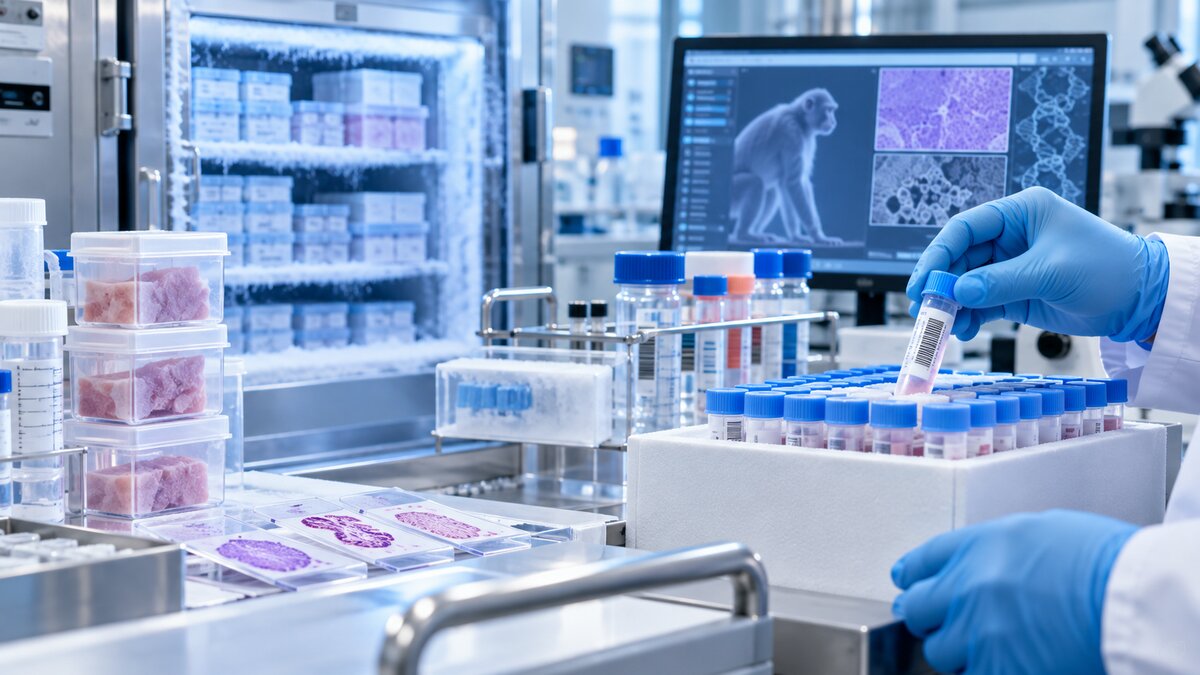

Creative Biolabs is highlighting non-human primate (NHP) biological resources for researchers seeking to balance scientific relevance with responsible animal use. Its portfolio includes tissue-derived immune cells, cell lines, immortalized cells, and tissue blocks, offering complementary materials for investigating biological mechanisms and developing assays while making more systematic use of existing biospecimens.
Making Better Use of Existing NHP Biospecimens
Could more systematic use of existing NHP cells and tissues help researchers address selected scientific questions while reducing the need for additional animal studies?
For biobanks and translational research teams, this question places scientific resource utilization alongside the principles of replacement, reduction, and refinement – the 3Rs. One public example is the National Institute on Aging (NIA) Nonhuman Primate Tissue Bank, which states that it supports the 3Rs by maximizing the use of existing banked NHP samples. This example provides useful context for responsible biospecimen use and should not be interpreted as implying any partnership or affiliation with Creative Biolabs.


Creative Biolabs’ NHP biologicals for translational research bring together cellular materials, tissues, and related research capabilities. For investigators, the practical opportunity is to select specimens around a defined biological question rather than treat primate origin alone as evidence of suitability.
Different Materials Answer Different Questions
In immunology, anatomical origin matters. Blood-based measurements do not fully describe immune populations within lymphoid tissues. Research mapping rhesus macaque peripheral blood, lymph nodes, and bone marrow has demonstrated distinct cellular compositions and marker patterns, underscoring the importance of tissue selection and species-appropriate reagent validation.
Within this context, tissue-derived immune cells provide a route for investigating immune populations beyond circulating cells. Such studies require attention to cell identity, preparation quality, and assay compatibility. In a 2022 Communications Biology study, researchers used high-throughput flow cytometry to screen 361 commercially available anti-human antibody clones and identified 112 clones as cross-reactive with rhesus macaque cells. The authors also noted that their positivity thresholds could exclude markers present on smaller cell populations, so the figure should not be interpreted as an absolute count of all potentially cross-reactive markers.
For repeated cell-based experiments, the company also offers NHP cell lines and immortalized NHP cells. These resources support sustained in vitro work, but extended culture is not equivalent to unchanged biology. Passage-related genetic and phenotypic changes can affect experimental results, making authentication, passage control, and functional characterization important safeguards.
Meanwhile, NHP tissue blocks provide complementary material for tissue-level investigations. Frozen and paraffin-embedded preparations should be selected according to the intended analytical method, not convenience alone. Collection, preservation, and processing conditions influence downstream suitability, so assay requirements should guide procurement from the outset.
The Evidence Must Extend Beyond the Specimen
For biobanking professionals, a useful sample is more than a labeled vial or block. Source information, processing history, preservation conditions, and quality-control results help researchers interpret findings and compare materials appropriately. The National Cancer Institute’s biospecimen data standardization framework identifies provenance and quality-control metadata as core components of standardized sample information, while the NCI Best Practices for Biospecimen Resources emphasize consistent collection, processing, storage, data management, and QA/QC practices to support reproducible research.
Cell-based workflows also require contamination controls. Mycoplasma contamination can alter cell physiology and gene expression without obvious visual warning, potentially undermining reproducibility. Routine testing and documented handling practices therefore remain important even when materials come from an established supplier.
Responsible specimen use can increase the scientific value obtained from existing animal-derived resources, but it should not be presented as animal-free research or proof that every whole-animal study can be replaced. The stronger proposition is narrower: use appropriate banked materials where they can answer the question, and justify additional animal work against the evidence still needed.
About Creative Biolabs
Creative Biolabs provides biological products and research services supporting drug discovery and translational investigations. Its NHP platform includes biospecimens, sample collection and biobanking, and related analytical capabilities. These resources support researchers selecting materials and designing studies around specific scientific objectives.
About the Author

Creative Biolabs supports laboratory NHP preclinical studies with a wide array of biological products, including whole blood, serum, plasma, primary cells, tissue, body fluids, and recombinant reagents. As a specialized contract research organization, we offer diverse NHP disease models, providing biologicals from diseased primates. Recognizing the complexity and sensitivity of NHPs in biomedical research, we have developed specialized infrastructure and care to maintain their well-being. Despite the controversy surrounding NHP use, we ensure a steady supply and high-quality service to meet the urgent needs of biomedical research through our dedicated monitoring and evaluation platform.